Skip to content

Medical Device Industry

EU MDR – Medical Device Regulation Certification for Market Access

As a globally recognized notified body, TÜV NORD supports you in achieving MDR certification for your medical devices. We help ensure your products meet EU safety and quality standards, making them compliant and market-ready.

Request a quote now
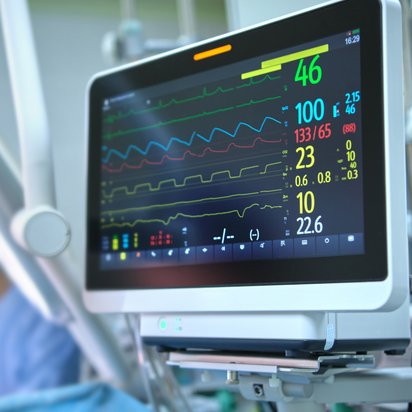
The image shows a heart rate and patient condition monitor in a hospital operating room during a surgical procedure

What is EU MDR – Medical Device Regulation?

The European Union Medical Device Regulation (EU MDR) – officially known as Regulation (EU) 2017/745 – establishes a unified framework for ensuring the safety, performance, and clinical effectiveness of medical devices marketed in the European Economic Area (EEA). It aims to strengthen patient protection, increase transparency, and improve post-market surveillance throughout the entire product lifecycle.

The MDR entered into force on 26 May 2017 and became fully applicable on 26 May 2021, replacing the Medical Device Directive (93/42/EEC) and the Active Implantable Medical Device Directive (90/385/EEC). Devices previously certified under MDD or AIMDD must undergo recertification to continue being marketed in the EU under MDR. For the latest version of the MDR you can request our MDR booklet including M5.

Even manufacturers with existing approvals must comply with the new, more rigorous MDR requirements – including updated clinical evidence, technical documentation, and risk management procedures.

Although transition periods for legacy devices have been extended through recent amendments, the timeline to achieve compliance is limited. Early action is essential to avoid market disruption.

As a designated Notified Body under EU MDR, TÜV NORD CERT GmbH provides expert certification services to help medical device manufacturers meet regulatory requirements and ensure continued access to the European market.
Download our TÜV NORD MDR questionnaire now

Your benefits of MDR certification

While MDR (EU) 2017/745 compliance is legally required for placing medical devices on the EU market, working with an experienced notified body like TÜV NORD delivers strategic advantages:

  • While MDR (EU) 2017/745 compliance is legally required for placing medical devices on the EU market, working with an experienced notified body like TÜV NORD delivers strategic advantages:
  • Global network of auditors and experts
  • Provision of combined services such as MDR, MDSAP, ISO 13485 and ISO 9001
  • Meeting global regulatory requirements
  • Globally recognized notified and certification body
  • Reduced regulatory risk through high level of competence in our audit and expert teams  
  • Improved product quality and safety
  • Enhanced brand trust and credibility

Significant updates under EU MDR

Includes certain non-medical products (e.g. aesthetic devices, dermal fillers, skin treatments). Annex XVI

Many devices are now classified in higher risk categories.
Article 51

Each manufacturer must appoint a qualified person for compliance oversight.
Article 15

Ongoing monitoring and clinical follow-up are now mandatory.
Articles 83–100

High-risk devices require updated clinical evaluations and public safety summaries.
Articles 61–80

All devices must be recertified under MDR — no automatic approval from old MDD/AIMDD.
Valid until 26 May 2024

New technical benchmarks for certain device categories.
Article 9

Traceability system with phased deadlines by risk class (2021–2025).
Article 27

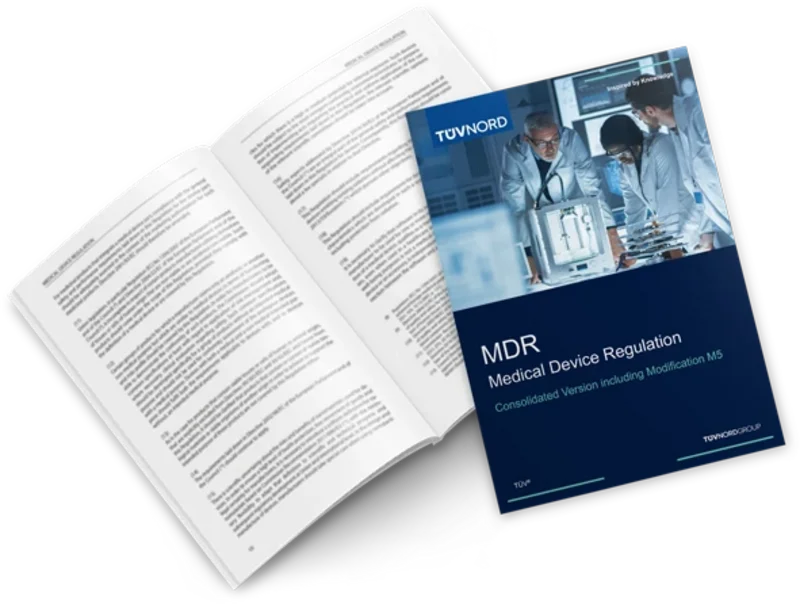
Medical Device Regulation (MDR) booklet

The MDR booklet contains the consolidated version of Regulation (EU) 2017/745 on medical devices, also known as the Medical Device Regulation (MDR). The MDR has been mandatory since May 26, 2021. The MDR replaced both the Medical Devices Directive (MDD) 93/42/EEC and the Active Implantable Medical Devices Directive (AIMDD) 90/385/EEC.

The audit process of MDR certification

1

Step 01

Inquiry and offer

2

Step 02

Order for the conformity assessment procedures, followed by TÜV NORD application review

3

Step 03

The audit and technical documentation assessment (TOA) programme is to be drafted, including the planning of unannounced audits and technical document sampling.

4

Step 04

Review of the technical and clinical documentation

5

Step 05

Stage 1 and 2 QM system audits: consultation procedure, if appropriate, and validation of the SSCP (Summary of Safety and Clinical Performance), if appropriate.

6

Step 06

Management of nonconformity in TD and QM

7

Step 07

Release and certification decision by TÜV NORD

8

Step 08

Certificate issued and released into the EUDAMED database.After the certificate has been issued:Ongoing post-market surveillance and data analysis, with modification of the audit and TOA programmes as required.

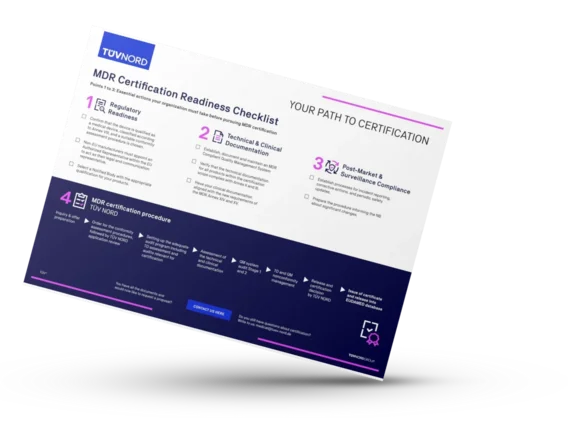
TÜV NORD MDR Readiness Checklist

TÜV NORD MDR readiness checklist

Is your company ready for MDR certification? This MDR readiness checklist is designed to help manufacturers assess their current documentation, processes, and organizational setup before applying for certification under the EU Medical Device Regulation (EU) 2017/745.

Download now

FAQs on MDR certification

The EU Medical Device Regulation (MDR – Regulation (EU) 2017/745) entered into force on 26 May 2017 and became fully applicable on 26 May 2021, replacing the former Medical Device Directive (MDD 93/42/EEC) and Active Implantable Medical Device Directive (AIMDD 90/385/EEC).

Transition deadlines have been extended for various reasons to support continued access to medical care in the EU.

MDR was introduced to strengthen patient safety and improve the transparency of medical device regulation across the EU. It addresses weaknesses in the previous system by introducing stricter clinical evaluation, post-market surveillance, and traceability through UDI (Unique Device Identification). MDR also expands the scope to include more types of products and ensures a higher standard of quality for devices marketed in Europe.

All devices previously covered under MDD and AIMDD remain regulated under MDR. However, new classifications and product groups have been added, including:

- Reusable surgical instruments – now classified under Class I (reusable surgical) and require Notified Body involvement for aspects like cleaning, sterilization, and reprocessing.

- Non-medical products listed in Annex XVI of the MDR

If your device does not have a valid MDR certificate (or extended MDD certificate under the transitional rules), it cannot be legally placed or made available on the EU market.

Contact

Do you have a question or want to request a proposal? Contact us now!
Project management heads from TÜV NORD

TÜV NORD´s Project management circle (PMC)

Our Project Management Circle is a global network of experienced project managers supporting healthcare and medical device organizations. Find out how PMC can help you streamline your processes.