Skip to content

ISO 50001 - Energymanagement

Promotes energy efficiency and helps companies reduce greenhouse gas emissions and lower energy costs. A certified energy management system continuously improves energy performance and strengthens competitiveness.

Request an offer now

ISO 50001: Certified energy management system

Organizations with structured energy management systems are able to monitor, evaluate and continuously improve their energy performance in a systematic way. Implementing an energy management system in line with DIN EN ISO 50001 creates a verifiable framework for managing energy use, reducing emissions, and improving operational transparency. 

Beyond environmental considerations, ISO 50001 also supports organizations in refining internal processes related to energy consumption and resource efficiency. A certified system confirms that defined procedures for monitoring, analysis and improvement are effectively implemented. 

TÜV NORD Middle East conducts independent certification and audit processes to verify compliance with ISO 50001 requirements. 

Request ISO 50001 Certification

Target group

An energy management system according to ISO 50001 is applicable to organizations of all sizes and sectors. It is particularly relevant for: 

  • Manufacturing companies with significant energy demand
  • Infrastructure and facility management organizations
  • Service providers operating large-scale operations
  • Companies active in international supply chains, including the Middle East and GCC region 

The standard provides a structured approach to demonstrating energy-related performance across different operational environments.

ISO 50001: Your advantages at a glance

  • Systematic evaluation of energy consumption and performance indicators
  • Identification of energy-saving opportunities across processes and operations
  • Increased awareness of energy efficiency among employees and supply chain partners
  • Reduction of energy-related costs through optimized consumption 
  • Contribution to environmental targets through lower greenhouse gas emissions 


  • Strengthening of market positioning in international B2B environments
  • Qualification for regulatory incentives where applicable
  • Exemption from certain energy audit obligations (e.g. DIN EN 16247-1)
  • Improved transparency in sustainability and ESG reporting 
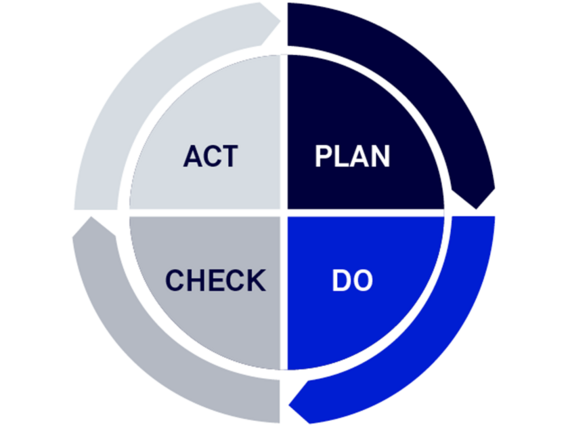
Infografik PDCA Zyklus - Das Vorgehen: Plan-Do-Check-Act

The Plan-Do-Check-Act model as the basis for your energy management system in accordance with ISO 50001

ISO 50001 follows the Plan-Do-Check-Act (PDCA) cycle, ensuring a structured and ongoing improvement process. 

Plan: Assessment of the current energy baseline, definition of energy objectives, identification of significant energy uses (SEUs), and establishment of energy performance indicators (EnPIs). 

Do: Implementation of processes, controls and communication structures required for managing energy performance across the organization. 

Check: Monitoring and measurement of energy-related results, including internal evaluations and management review. 

Act: Adjustment of targets, policies and measures to ensure continuous improvement and alignment with operational developments.

The audit process for ISO 50001 certification

1

Step 01

Enquiry, offer preparation & explanation

2

Step 02

Commissioning & individual scheduling

3

Step 03

Audit: Understanding the organisation & determining readiness for certification

4

Step 04

Identifying potential for improvement

5

Step 05

Fast four-eye check & certificate creation

6

Step 06

External TÜV certificate

7

Step 07

Continuous further development of the management system & competitiveness

Integrated Management System (IMS): Significance and Advantages

An integrated management system (IMS) combines various management systems—such as quality, environmental, energy, and occupational health and safety—into a unified and standardized framework. This creates a consistent approach to processes, enhances transparency, and supports efficient coordination across the organization.

  • Increased efficiency: Harmonized processes reduce duplication and enable more targeted use of resources.
  • Cost reduction: Eliminating redundant activities leads to measurable financial benefits.
  • Clear responsibilities: Defined roles and accountabilities provide structure and orientation.
  • Combined audit processes: Overlapping requirements can be assessed within a single audit framework.
  • Greater employee motivation: Transparent structures and clearly defined objectives support acceptance and engagement.
  • Trust from customers and partners: Certification demonstrates structured processes and organizational reliability.
  • Flexibility and adaptability: New regulatory or market requirements can be integrated more efficiently.
  • Improved decision-making: Centralized data supports consistent analysis and strategic planning.


An IMS contributes to improved efficiency, reduced costs, enhanced transparency, and stronger collaboration across the organization, while supporting compliance with applicable requirements. Successful implementation depends on structured planning and consistent execution. The High Level Structure (HLS) provides the common foundation for integrating multiple ISO standards into a cohesive system.

Mehr über IMS erfahren

Frequently asked questions

FAQ on ISO 50001

ISO 50001 is an international standard that defines requirements for the establishment, implementation, and continuous improvement of an energy management system. The objective is to enable organizations to systematically improve energy performance, including energy efficiency, energy use, and consumption.  

The standard is applicable to organizations of all sizes and sectors. It is particularly relevant for companies with significant energy consumption, multi-site operations, or participation in international supply chains, including organizations active in the Middle East and GCC region.

ISO 50001 requires organizations to:

  • Establish an energy policy
  • Identify significant energy uses (SEUs)
  • Define energy performance indicators (EnPIs)
  • Monitor and analyze energy consumption data
  • Implement measures to improve energy performance
  • Conduct regular internal audits and management reviews

No. TÜV NORD operates exclusively as an independent body for audit and certification.
Consulting, implementation support, and certification activities are strictly separated.

The duration depends on factors such as organizational size, complexity, number of sites, and level of system maturity. The process typically includes preparation, Stage 1 and Stage 2 audits, and the certification decision.

Yes. ISO 50001 can be integrated with other standards such as ISO 9001 (quality management), ISO 14001 (environmental management), and ISO 45001 (occupational health and safety) within an integrated management system (IMS), based on the High Level Structure (HLS).

Certification supports organizations in:

  • Improving energy efficiency
  • Reducing operational costs
  • Enhancing transparency of energy performance
  • Supporting compliance with regulatory requirements
  • Strengthening positioning in international markets and supply chains