Skip to content

Certification (EU) 2017/745 Medical Devices Regulation (MDR)

Safe on the EU market. As a globally recognized Notified Body, TÜV NORD supports manufacturers in achieving MDR certification for medical devices. The Medical Device Regulation (EU) 2017/745 establishes the European requirements for safety, quality, and performance. We help ensure your products are compliant and ready for market access

Contact Our Experts

The New Medical Devices Regulation (MDR EU)

Regulation (EU) 2017/745 on Medical Devices (MDR) entered into force on 26 May 2021, replacing the Medical Devices Directive 93/42/EEC (MDD) and the Active Implantable Medical Devices Directive 90/385/EEC (AIMDD).

The regulation introduces significantly stricter requirements for manufacturers seeking to market medical devices within the European Union. Changes include enhanced clinical evaluation, stronger post-market surveillance, increased technical documentation requirements, and more rigorous conformity assessment procedures involving a designated Notified Body.

As a designated European Notified Body, TÜV NORD CERT continues to support manufacturers throughout the MDR certification process, helping them achieve compliance and maintain access to the European market.

Who Needs MDR Certification?

MDR certification is intended for manufacturers of medical devices that are placed on the European Union market. It is also relevant for companies acting as legal manufacturers, importers, distributors, and product developers responsible for regulatory compliance under Regulation (EU) 2017/745.

Organizations of every size, from startups to multinational manufacturers, require MDR certification when marketing regulated medical devices within the EU.

Medical Device Classification under MDR

Before beginning the certification process, manufacturers must classify their medical devices according to Annex VIII of Regulation (EU) 2017/745. Device classification determines the applicable conformity assessment procedure and the level of regulatory review required by the Notified Body.

Medical devices are categorized into four risk classes:

• Class I
Low-risk devices

• Class IIa
Low to medium risk devices

• Class IIb
Medium to high-risk devices

• Class III
Highest risk devices

Medical Device Regulation

The Most Important Changes for Medical Devices Manufacturers

The new Medical Devices Regulation no longer only applies to traditional medical Devices, but also to products “without an intended medical purpose” (Annex XVI – List of product groups in this category).

Among others, products for “body modification” and “beautification” are included, in other words, products which are used by the consumer without a specific medical purpose stated by the manufacturer. Products for liposuction, hair removal and skin resurfacing are also affected.


In order to keep pace with technical developments, the classification rules have now been changed. For many manufacturers, this means that their products may be classified in a higher class.

Manufacturers must appoint at least one person who is responsible for regulatory compliance (PRRC). Article 15 of the Medical Devices Regulation (MDR) describes the qualification profile and the tasks of the PRRC in detail.

The responsibility of the manufacturer with regard to post-market surveillance has been newly defined. The Medical Devices Regulation requires ongoing and systematic documentation which also fulfils the new requirements for Post Market Clinical Follow-Up (PMCF).

The MDR requires a clinical evaluation of existing clinical studies and publications with regard to safe and effective use of the medical Devices. These documents are assessed by<s> </s>our clinical experts within the framework of the conformity assessment procedure.

The Medical Devices Regulation does not provide a right of continuance for products with existing certification. This means that medical Devices which are already approved at the present time have to be newly assessed and certified. Medical Devices approved under the MDD may only be placed on the market up to 26 May 2024.


In addition to “harmonized standards” there are now so-called “common specifications (CS)” for design and manufacture of medical Devices (MDR Art. 2,71). These contain detailed information on technical specifications, necessary processes, and evidence to be provided for certain product categories in order to demonstrate compliance with the given safety and performance requirements.  However, their use is voluntary if it can be proven that the solutions adopted ensure a level of safety and performance that are at least equivalent to the state of the art.

Manufacturers of Class III medical Devices have to draw up and publish regular reports regarding their clinical performance (“Summary of safety and clinical performance”, SSCP). This is intended to ensure that members of the public who make use of the Devices can access up to date information about them.

In order to allow the identification and facilitate the traceability of Devices, the Medical Devices Regulation has introduced a system for unique Devices identification (Unique Devices identifier - UDI).

All medical Devices must be provided with a UDI Devices identifier (‘UDI-DI’) specific to a manufacturer and a Device. Following a transitional period dependent on the risk class, these identifiers have to be placed on the label of the Devices or on its packaging so as to be easily readable by man and machine.

Installation of the unique Devices identification system is mandatory for all Devices as from 26 May 2021. However, the label only has to be attached to the Devices or packaging at the end of the transitional period specified for the respective risk class, as shown below:

26 May 2021:
Implantable Devices and Class III Devices

26 May 2023:
Class IIa and IIb Devices

26 May 2025:
Class I Devices

If the products can be re-used, the UID-DI has to be placed directly on the product no later than 2 years after the above deadlines, for example by means of laser engraving (direct marking).

Overview of the MDR Certification Process

1

Step 01

Inquiry and Offer

2

Step 02

Order for the conformity assessment procedures, followed by TÜV NORD application review

3

Step 03

Drafting of the audit and technical documentation assessment (TOA) programme including planning of the unannounced audits and technical document sampling

4

Step 04

Review of the technical and clinical documentation

5

Step 05

QM system audit Stage 1 and 2: Consultation procedure if appropriate & validation of the SSCP (summary of safety and clinical performance) if appropriate

6

Step 06

TD and QM nonconformity management

7

Step 07

Release and certification decision by TÜV NORD

8

Step 08

Issue of certificate and release into EUDAMED database. After issue of the certificate: ongoing post-market surveillance and data analysis with modification of the audit programme and TOA programme as required

Ready to Enter the European Market?

Partner with TÜV NORD to achieve MDR certification and demonstrate compliance with the latest European regulatory requirements.

TÜV NORD Documents for Download

Checklist

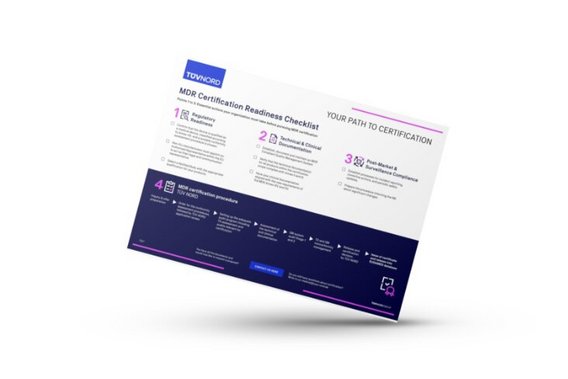
Checklist: MDR Readiness

Is your company ready for MDR certification? This MDR readiness checklist is designed to help manufacturers assess their current documentation, processes, and organizational setup before applying for certification under the EU Medical Device Regulation (EU) 2017/745.
Download Checklist Now
FACTSHEET

Factsheet: MDR-Certification

Download our MDR certification factsheet to learn how medical device manufacturers can meet EU compliance standards.
Download our factsheet now

FAQs on the MDR – Medical Devices Regulation

The Medical Devices Regulation, officially referred to as (EU)2017/745, is a harmonised regulation. Manufacturers who fulfil the requirements of the regulation are permitted to label their Devices with the CE mark and can sell them in all EU member states and EFTA states without the need for further certification or approval.

The Medical Devices Regulation replaced the previous European Directives on 26.05.2021. This means that it is the only set of rules which governs the placement of medical Devices on the market in Europe.  

For manufacturers who have submitted an MDR application to a Notified Body, transitional provisions apply to the placing on the market of their products that have not yet been covered by an MDR certificate. Depending on the classification and provided that no significant changes are made, these so-called legacy devices may be placed on the market until 31 December 2028.

In March 2023, the European Commission amended the transition provisions for medical devices with Regulation (EU) 2023/607 as a supplement to the Medical Device Regulation (MDR 2017/745). Manufacturers must observe the following deadlines and transition rules to ensure the compliance of their products with the MDR:

31 December 2027

  • End of the transition period for Class III medical devices and Class IIb implants (applies only if no exemptions apply)

31 December 2028

  • End of the transition period for all other Class IIb, Class IIa, and Class I (sterile/measuring) medical devices

The Medical Devices Regulation lays down the requirements for the safety and performance of medical Devices and the requirements for the quality systems which govern their development, manufacture and placement on the market.

European Commission / Nando (TÜV NORD CERT Notified Body) und Designation scope 

ZLG  (Zentralstelle der Länder für Gesundheitsschutz bei Arzneimitteln und Medizinprodukten)

MDCG (Guidance - MDCG endorsed documents and other guidance)

EUDAMED (European Database on Medical Devices)

Over almost 25 years of harmonised requirements for medical Devices, technology and the approach taken by courts of law developed and changed. In the light of this it became necessary to reconsider existing European Directives regarding medical Devices, active implantable Devices and in-vitro diagnostics.  

The creation of the new Medical Devices Regulation (MDR) was also triggered by the breast implant scandal. The new legislation is intended to prevent re-occurrence of similar events in future.

The new regulation has the advantage that it does not need to be implemented in the individual member states through transposition into national law. This allows uniform interpretation of the requirements and means that the regulation can be used directly by manufacturers in its current published form.